Plant-Based Protein, Amino Acids and B12: Your Daily Targets
Set daily protein targets by body weight and get enough essential amino acids. Learn which plant foods deliver protein and how to dose vitamin B12.
У цій статті
A bowl of lentil soup and a slice of toast can make a satisfying lunch. The useful questions are how many lentils are in the bowl and whether the rest of your day supplies enough protein. You do not need to check whether the lentils and bread form a perfect amino acid pair. Vitamin B12, though, needs a separate plan. Neither food reliably supplies it unless fortified.
For most healthy adults eating plant-based, use 0.9 to 1.0 g of protein per kg of body weight per day as an everyday planning target. If you train regularly, start at 1.2 to 1.6 g/kg/day. For B12 maintenance, choose 50 mcg of cyanocobalamin daily or 2,000 mcg once weekly. Here is how to turn those numbers into portions and habits you can repeat.
1. Calculate your daily protein target
Multiply your body weight in kilograms by the lower and upper ends of the range. If you weigh yourself in pounds, divide by 2.205 to convert to kilograms. At 70 kg (154 lb), the everyday target is 63 to 70 g per day. The regular training target is 84 to 112 g per day. You do not have to hit the same number to the gram every day.
The WHO/FAO/UNU report gives 0.83 g/kg/day as the safe intake level for healthy adults consuming good-quality protein. The 0.9 to 1.0 range here is a practical planning target, not a separate WHO recommendation or a claim that all vegans need more protein. The small margin is useful when your meals vary in protein quality and portion size.
The Academy of Nutrition and Dietetics, Dietitians of Canada, and the American College of Sports Medicine give a broader sports range of 1.2 to 2.0 g/kg/day. For many recreational athletes, 1.2 to 1.6 is a sensible starting point. If you lift regularly, aim toward the upper end. High training volume or an energy deficit can justify a target above 1.6. If you have kidney disease or a prescribed protein restriction, ask your clinician for an individual target rather than using a general range.
Use Veganistik’s daily Protein, Hydration & B12 Calculator as a place to check these three priorities. For protein, start with your target, then look at what you actually ate on two or three typical days. If you keep falling short at lunch, change lunch before buying a protein powder.
2. Stop trying to combine proteins at every meal
Your body needs nine essential amino acids from food, but they do not all have to arrive in the same bite or meal. The Academy’s 2016 position paper explains that protein from a variety of plant foods can supply enough essential amino acids when calorie intake is adequate. The WHO/FAO/UNU report evaluates protein quality using essential amino acid content and digestibility. Those differences matter, but they are not a reason to pair specific foods at every sitting.
Most plant proteins contain all nine essential amino acids, just in different proportions. Many grains are relatively low in lysine, while legumes such as lentils, beans and peas are useful lysine sources. You can eat oats at breakfast, lentil soup at lunch and rice with vegetables at dinner. The lentils do not have to move to dinner to make the rice count.
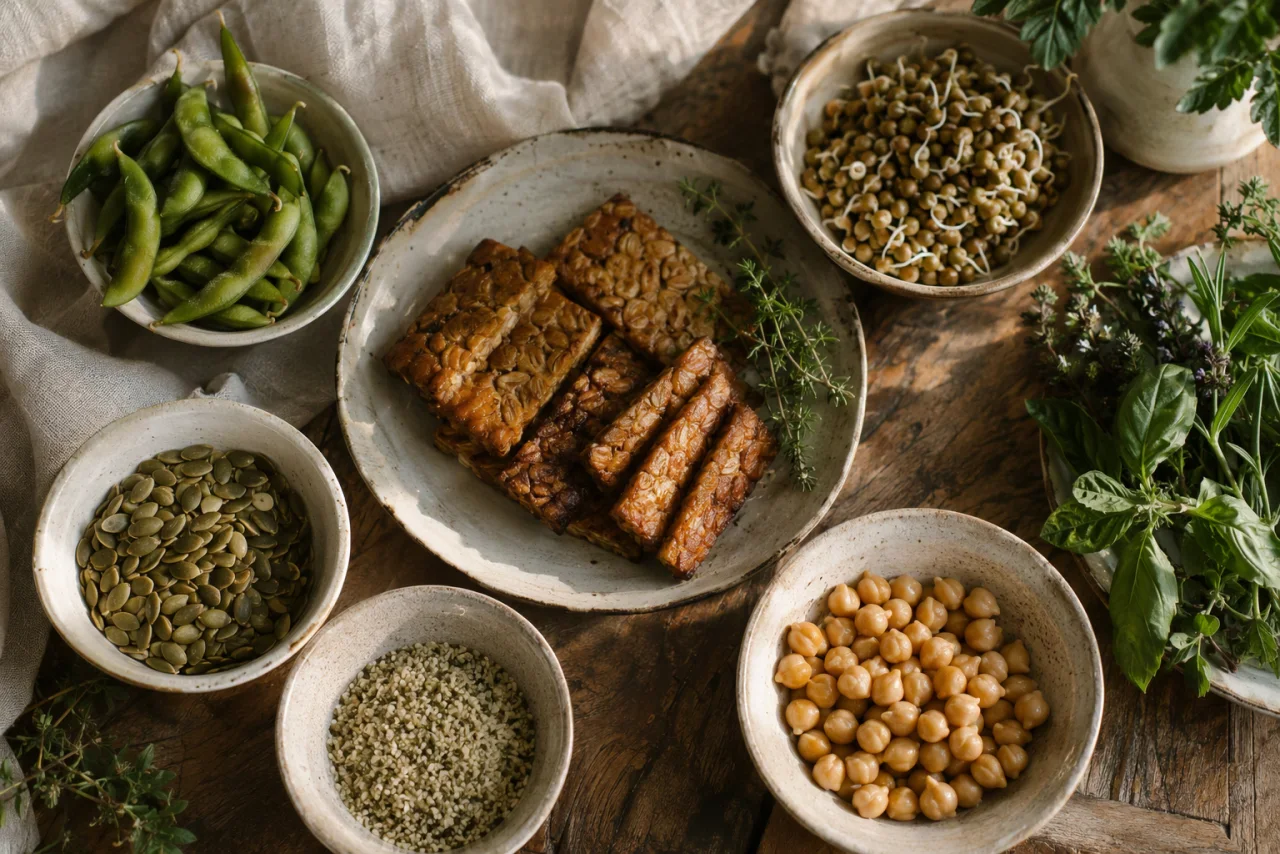
Where variety becomes practical: if most of your protein comes from bread, pasta and seitan, add beans, tofu, edamame or another legume regularly. If you are eating very little overall, pay attention to both calories and protein. A salad with a spoonful of hummus and a few seeds can be a good side, but it is unlikely to do the work of a full meal if you are aiming for 90 g of protein a day.
3. Build meals around portions that deliver protein
These USDA FoodData Central values use edible portions, with cooked weights where specified. They are rounded to one decimal place. A whole cup of lentils is a substantial serving, so count roughly 9 g, not 18 g, if your bowl contains only half a cup.
| Plant food | Serving | Protein |
|---|---|---|
| Edamame, cooked and shelled | 1 cup (155 g) | 18.5 g |
| Lentils, boiled | 1 cup (198 g) | 17.9 g |
| Firm tofu, prepared with calcium sulfate | 100 g | 17.3 g |
| Black beans, boiled | 1 cup (172 g) | 15.2 g |
| Chickpeas, boiled | 1 cup (164 g) | 14.5 g |
| Pumpkin seed kernels, dried | 1 oz (28 g) | 8.5 g |
| Quinoa, cooked | 1 cup (185 g) | 8.1 g |
A cup of black beans and a cup of cooked quinoa add up to about 23 g. At dinner, 150 g of the tofu in the table gives you about 26 g before any sides. Those are useful starting points for a 70 g day. If your target is closer to 100 g, it may be easier to plan a protein-rich breakfast and snack than to make dinner twice as large. The tofu figure is for a specific USDA entry, not every block of firm tofu. Check the package, especially if you switch types or brands.
For weeknights, Veganistik’s Cook From Your Fridge is useful when you have half a block of tofu or an open can of beans and need a meal idea. Its 260+ everyday recipes give you options to repeat, and the 1-tap Craving Swap helps when you want a plant-based version of something familiar. Check the protein in the actual portion rather than assuming the swap matches the original. At the store, the barcode & OCR label scanner and 200+ E-codes reference can help with ingredient checks. Read the nutrition panel separately for protein and look for explicitly listed B12 if you are buying a fortified food.
4. Choose a B12 schedule you can keep
For a healthy vegan adult with normal absorption, choose cyanocobalamin 50 mcg once daily or 2,000 mcg once weekly for maintenance. These are alternatives, not doses to take together. Check the amount per tablet rather than per serving, since a label may define a serving as more than one tablet.
The adult U.S. recommended dietary allowance is 2.4 mcg per day. That is an intake recommendation, not the amount to look for in a once-weekly supplement. At a large single dose, only a small fraction is absorbed. That is why the weekly dose is much larger than seven times the daily dose, rather than a simple conversion.
Fortified foods can supply B12 if you verify the dose and eat them consistently. Do not count unfortified nutritional yeast, spirulina or fermented foods as reliable sources. If you have a diagnosed deficiency, numbness or tingling, or a history of bariatric surgery or other absorption problems, get medical advice rather than relying on a maintenance schedule. Pregnancy, breastfeeding and childhood also warrant guidance tailored to the person.
5. A practical checklist for the week ahead
- Write down your body weight in kilograms and your daily protein range.
- Pick two repeatable meals built around tofu, beans, lentils or edamame. Measure your normal serving once so you know what it contributes.
- Check a typical day in Veganistik’s Protein, Hydration & B12 Calculator. If you miss your protein target, identify the meal with the least protein and start there.
- Pick one B12 schedule. Put the daily bottle by your breakfast mug or set a weekly reminder for a day you rarely travel.
- Plan one restaurant fallback. Search the Global Vegan Map, use the AI Menu Reader to spot likely options and show the 30-language Waiter Card to confirm ingredients. The app supports 30 languages. Ask whether tofu or beans can be added if the dish is mostly vegetables or starch.
If eating out is the part that keeps tripping you up, Vegan Connect and real-life Vegan Dining Tables offer ways to meet people and share practical restaurant finds. If environmental motivation helps you keep the habit, Veganistik’s Earth & Animal Impact Dashboard draws on Poore and Nemecek’s research and includes 110 botanical milestones. Use those milestones for motivation, not as a substitute for checking your portions or taking B12.
References
- WHO/FAO/UNU. Protein and Amino Acid Requirements in Human Nutrition. WHO Technical Report Series 935, 2007.
- Melina V, Craig W, Levin S. Position of the Academy of Nutrition and Dietetics: Vegetarian Diets. Journal of the Academy of Nutrition and Dietetics, 2016.
- Thomas DT, Erdman KA, Burke LM. Nutrition and Athletic Performance. Journal of the Academy of Nutrition and Dietetics, 2016.
- USDA Agricultural Research Service. FoodData Central. Source for the food composition table.
- Baroni L et al. Vegan Nutrition for Mothers and Children: Practical Tools for Healthcare Providers. Nutrients, 2018. See the maintenance table for adults. The Vegan Society’s B12 guidance lists the once-weekly option.
- NIH Office of Dietary Supplements. Vitamin B12: Fact Sheet for Health Professionals.
- Poore J, Nemecek T. Reducing Food’s Environmental Impacts Through Producers and Consumers. Science, 2018.
Поширені запитання
How much protein should I eat on a plant-based diet?
For most healthy adults, 0.9 to 1.0 g per kg of body weight per day is a practical everyday target. If you train regularly, start with 1.2 to 1.6 g/kg/day. Some athletes need more, depending on training volume and energy intake.
Do vegans need to combine proteins at every meal?
No. A varied plant-based diet that provides enough calories and protein can cover all nine essential amino acids across the day. Beans do not have to be eaten at the same meal as rice.
Which plant foods are high in protein per serving?
One cup of cooked shelled edamame has about 18.5 g of protein, one cup of cooked lentils has 17.9 g, and 100 g of firm calcium-set tofu has about 17.3 g. Tofu varies by brand, so check the label.
How much vitamin B12 should a vegan adult take?
For healthy adults with normal absorption, a practical maintenance schedule is 50 mcg of cyanocobalamin daily or 2,000 mcg once weekly. Choose one schedule. These are not treatment doses for a diagnosed deficiency.
Застосуйте поради з цього матеріалу вже сьогодні
Скануйте етикетки за 1 секунду, знаходьте альтернативу улюбленим стравам, розраховуйте норми білка й B12 та знайомтеся з веганами поблизу за спільним столом.
Читайте далі
The 30-Day Plant-Based Blueprint for a Low-Stress Transition

Veganistik vs HappyCow, Abillion and Fig: A Whole-Day Test