
Water, Carbon, and Land: What Plant-Based Meals Really Save
Oxford researchers tracked food impacts across 38,700 farms. See what the data says about beef, tofu, and lentils, and how to track your own meal swaps.
本文内容
You are making tacos, and the choice is between browning ground beef and crisping a block of tofu. The tortillas, cabbage, and salsa stay the same. That one substitution can change the climate footprint of dinner far more than switching the packaging or choosing a more local version of the same protein. But if your main concern is water, the answer is less straightforward: what you buy, where it was grown, and how it was irrigated all matter.
Joseph Poore and Thomas Nemecek’s 2018 study in Science gives us a way to separate those questions. It draws on data from approximately 38,700 farms in 119 countries and covers 40 food products. Its practical lesson is not that every plant food wins on every measure. It is that replacing particularly high-impact proteins, especially beef and lamb, is one of the clearest changes you can make, and that carbon alone cannot tell you the whole story.
What the Oxford analysis actually measured
Poore, then at the University of Oxford, and Nemecek, at Switzerland’s Agroscope, compared foods using life cycle assessment. Instead of looking only at what happened on the farm, they accounted for stages such as feed production, land use change, processing, packaging, transport, and retail where relevant. The results below describe food supply chains, not the energy your stove uses or the leftovers you throw away.
- Greenhouse gas emissions are expressed as carbon dioxide equivalents, or CO₂e. This combines gases such as carbon dioxide, methane from ruminant digestion, and nitrous oxide from soils and manure into a comparable climate measure.
- Land use measures how much land is occupied over time. It includes pasture as well as cropland used for feed or food. It does not mean that all occupied land was recently cleared or that all grazing land could grow crops.
- Freshwater withdrawals measure water taken from rivers, lakes, and groundwater, not all the rain that fell on a field. They are not the same as net water consumption, since some withdrawn water may return to its source. A liter withdrawn in a water-stressed basin can also have very different consequences from a liter withdrawn in a water-abundant region.
- Eutrophication potential estimates the pressure nutrient pollution puts on ecosystems. Nitrogen and phosphorus losses can fuel excess algal growth and deplete oxygen in water. The study expresses this potential in phosphate equivalents, not as grams of phosphate directly discharged.
Producers of the same food can have very different footprints. Even so, the study found that the impacts of the lowest-impact animal products typically exceeded those of plant substitutes. In its modeled global scenario without animal products, food-related land use fell by about 76% and food supply chain emissions by about 49%. Those are modeled changes to the food system, not percentages you can assign to an individual dinner.
Beef, lamb, cheese, and plant proteins compared
These are rounded global means per kilogram of food product from the Poore and Nemecek data published by Our World in Data. Beef here means beef from dedicated beef herds, which the study reports separately from beef produced in dairy systems. The dataset does not report lentils separately, so the lentil row uses the broader “other pulses” category as a reference, not a lentil-specific measurement.
| Protein source | Greenhouse gases (kg CO₂e) | Land use (m²·year) | Freshwater withdrawals (L) | Eutrophication (g PO₄e) | | : | -: | -: | -: | -: | | Beef, dedicated beef herd | 99.5 | 326.2 | 1,451 | 301.4 | | Lamb and mutton | 39.7 | 369.8 | 1,803 | 97.1 | | Dairy cheese | 23.9 | 87.8 | 5,605 | 98.4 | | Poultry | 9.9 | 12.2 | 660 | 48.7 | | Tofu | 3.2 | 3.5 | 149 | 6.2 | | Lentils, using other pulses as a proxy | 1.8 | 15.6 | 436 | 17.1 | | Peas | 1.0 | 7.5 | 397 | 7.5 | | Nuts | 0.4 | 13.0 | 4,134 | 19.2 |
The trade-offs stand out when you read across the rows. Lamb has lower greenhouse gas emissions than beef from dedicated herds but a higher average land requirement. Nuts have low average emissions but relatively high freshwater withdrawals. Cheese has lower emissions than either beef or lamb in this comparison, yet it has the highest freshwater withdrawal figure in the table. If water scarcity is your priority, look for regional sourcing information where available. The global liters column cannot tell you whether a particular farm was drawing on a stressed watershed.
A kilogram of tofu and a kilogram of beef do not supply the same amount of protein. On the dataset’s protein basis, 25 grams of protein from tofu corresponds to roughly 0.5 kg CO₂e, compared with 12.5 kg CO₂e from dedicated-herd beef. That’s a comparison of protein sources, not a full meal calculation. Oil, rice, toppings, and waste still count, and foods can differ in iron, calcium, and other nutrients even when their protein amounts match.
How to make a lower-impact meal you will cook again
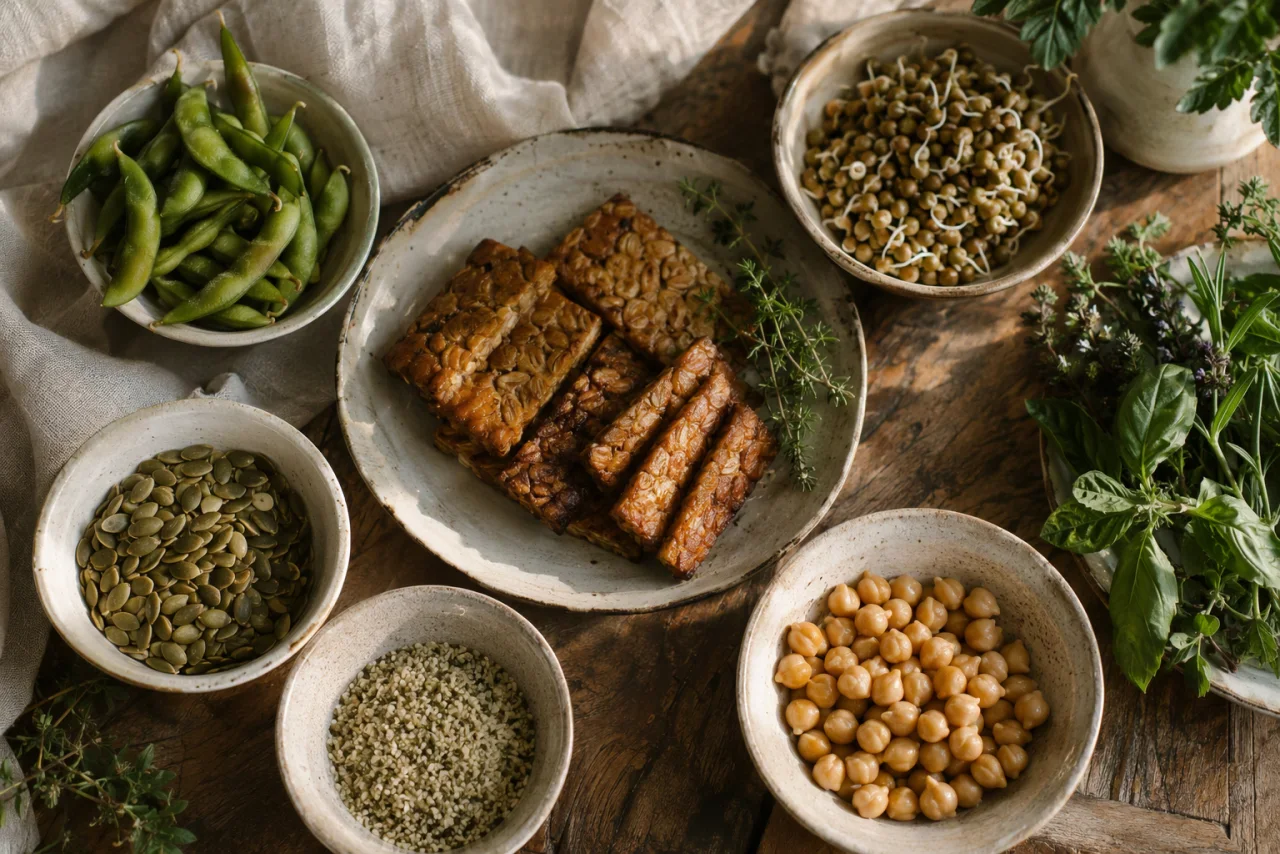
Start with the meal you already repeat. For tacos, crumble firm tofu into a hot pan and let it brown before adding the sauce. For a ground beef pasta sauce, simmer cooked lentils with browned mushrooms and tomato paste so the filling has enough body. If a cheese-heavy lunch is the habit you want to change, try a white bean and roasted pepper toast with lemon. The replacement works better when it does the same job: crisp filling, hearty sauce, or creamy topping.
Your next grocery trip checklist
- Pick one recurring beef or lamb meal to change first. A weekly swap is easier to sustain than an overhaul built around unfamiliar recipes.
- Choose the main protein before the garnish. Tofu, lentils, or split peas can anchor dinner; a scattering of nuts usually cannot.
- Compare the portions you will actually serve. Use protein-based figures if you want to compare like with like on protein, and remember that the rest of the plate still matters.
- Use what you have. Check the fridge before buying another set of ingredients, and freeze an extra portion if you will not eat it soon.
- Check ingredients separately from impact. A label can help establish whether a product is vegan, but it rarely tells you how much water was withdrawn to make it.
Veganistik’s Cook From Your Fridge helps when you have half a cabbage and an opened block of tofu, while the 1-tap Craving Swap helps you find an alternative when you want a specific dish rather than a lesson in emissions. Its 260+ everyday recipes give you options for repeating the swap without repeating dinner. For packaged ingredients, the barcode & OCR label scanner supports 30 languages and covers 200+ E-codes. That’s useful for checking ingredients, not for assigning a product its own life cycle footprint.
What the Earth & Animal Impact Dashboard can show you
Veganistik’s Earth & Animal Impact Dashboard uses Poore and Nemecek’s research as a reference to visualize estimated cumulative progress. A single taco night can feel inconsequential. Seeing a pattern build over weeks makes it easier to recognize that you have changed what you buy and cook regularly. The dashboard’s 110 botanical milestones mark that longer trajectory rather than asking you to judge the success of every plate.
The habit change is real. The footprint figures are estimates based on comparisons, not measurements from the farm that supplied your tofu. Read any estimated savings relative to the food being replaced. Switching from beef is a different comparison from switching from poultry or from another plant protein. A land-use estimate does not mean a specific field was restored, and animal-impact indicators should not be read as direct animal counts from the Poore and Nemecek study. Use the dashboard to see the direction and scale of a habit, not to audit a particular meal.
Keep the habit working at home and away
A lower-impact dinner still needs to be satisfying and meet your nutritional needs. Keep a few dependable protein staples on hand and, if you eat fully plant-based, make sure you have a reliable source of vitamin B12 from fortified foods or a supplement. Veganistik’s daily Protein/Hydration/B12 Calculator can help you check intake. The hydration part is about what you drink, not the water used to grow your dinner.
Eating away from home is often where a new routine gets harder. The Global Vegan Map can help you find options before you leave, and the AI Menu Reader and 30-language Waiter Card can help you identify dishes and confirm ingredients with staff. If you want company or ideas from people who already cook this way, Vegan Connect and real-life Vegan Dining Tables make the change more social.
If you only do one thing with the study, replace one beef or lamb dinner you eat often with a plant protein you genuinely enjoy. Give yourself a few tries to get the seasoning and texture right. The most useful swap is the one that earns a permanent place in your grocery basket.
References
- Poore J, Nemecek T. Reducing food’s environmental impacts through producers and consumers. Science. 2018;360(6392):987–992. Primary life cycle analysis.
- Ritchie H, Rosado P, Roser M. Environmental Impacts of Food Production. Our World in Data. Data presentation and comparison charts based on Poore and Nemecek.
- Scarborough P, et al. Vegans, vegetarians, fish-eaters and meat-eaters in the UK show discrepant environmental impacts. Nature Food. 2023;4:565–574. Peer-reviewed analysis of environmental impacts across observed dietary patterns.
常见问题
What did Poore and Nemecek find about plant-based foods?
Their global life cycle analysis found that even low-impact animal products typically exceeded plant substitutes on several environmental measures. The size of the gap depended on the food, producer, and metric.
Does tofu have a lower carbon footprint than beef?
Yes, on global averages. Poore and Nemecek's data put tofu at about 3.2 kg CO₂e per kilogram of product, compared with 99.5 kg CO₂e for beef from dedicated beef herds. Tofu also has a lower footprint per gram of protein.
Do plant-based foods always use less freshwater?
No. In the global dataset, nuts averaged about 4,134 liters of freshwater withdrawals per kilogram, compared with 1,451 liters for beef from dedicated beef herds. Local water scarcity also affects how consequential those withdrawals are.
How does Veganistik track the impact of plant-based meals?
Veganistik's Earth & Animal Impact Dashboard visualizes cumulative progress using Poore and Nemecek as a reference. Its 110 botanical milestones mark progress over time. The footprint figures are estimates, not measurements of individual meals.
今天就把这份指南用起来
1 秒扫描配料表,替换任何想吃的美食,计算蛋白质和 B12 目标,还能在线下聚餐中认识附近的素友。
继续阅读
The 30-Day Plant-Based Blueprint for a Low-Stress Transition

Veganistik vs HappyCow, Abillion and Fig: A Whole-Day Test